Beyond the S-Curve: Building a Defensible Enterprise in the Age of AI Copycats
Beyond the S-Curve: Building a Defensible Enterprise in the Age of AI Copycats
Every commercial leader, board member, and investor is currently scanning the horizon for the next S-curve. We have been conditioned to believe that technological inflections automatically yield commercial dominance. But in an AI-driven market, where the speed of software creation has outpaced the human capacity to absorb it, the real question is no longer which market will grow.
The far harder, more urgent question for CEOs and CROs is this: What kind of company can still scale when products, features, and workflows become effortlessly easy to copy?
Lower barriers to entry invariably create a flood of new companies. They do not, however, create durable ones. To achieve sustainable growth today, speed is merely table stakes. Survival requires a business contribution that is structurally and architecturally hard to replace.
1. The Great Shift: From Product Abundance to Buyer Paralysis
Artificial Intelligence is making software engineering, product design, and process automation remarkably cheap and accessible. But by making "building" easier, AI has fundamentally shifted the bottleneck of the B2B buying journey.
In a market saturated with lookalike solutions, the buyer’s core challenge is no longer discovering a tool that can solve their technical problem. The actual friction point has moved downstream. When a buyer looks at the modern tech stack, they aren't asking, "Can this product do the job?"
They are paralyzed by a deeper, structural anxiety: "Can I defend this specific decision inside my organization?"
To understand why deals stall, we must understand the dual-core emotional and strategic realities that govern high-stakes enterprise purchasing.
2. The Anatomy of Enterprise Anxiety: The Two Fears
Complex B2B buying journeys are driven by a continuous oscillation between evaluation and risk management. This cycle is dictated by two distinct architectural fears:
[The First Fear] ──> Activates Search ──> [Hope] ──> Triggers [The Second Fear] ──> Paralysis
                                                                 │
                                                       (Needs Trust Infrastructure)
The First Fear: The Vulnerability of the Current State
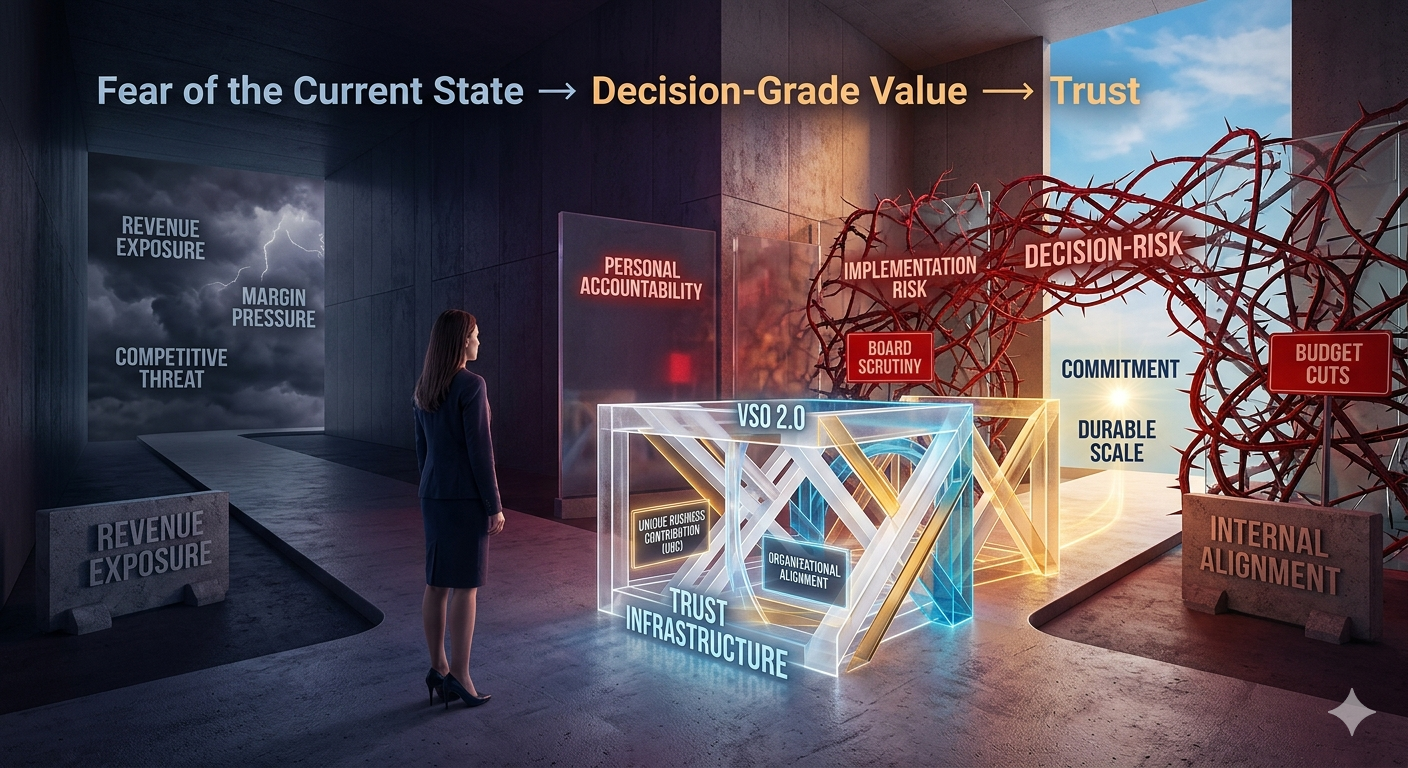
The buying journey begins with the fear of standing still. This fear rarely surfaces as pure emotion; it wears the sophisticated language of corporate strategy: revenue exposure, margin pressure, implementation failures, board scrutiny, or an aggressive competitive threat. The buyer realizes that continuing on the current trajectory creates an unacceptable exposure. The First Fear activates search. It forces the buyer to look outward, field demos, and engage with vendors. Search briefly creates hope.
The Second Fear: The Vulnerability of the Decision
The moment a vendor's solution begins to look credible, the psychological framing changes entirely. The buyer stops evaluating the vendor’s product capabilities and starts calculating their own personal accountability.
In a complex enterprise sale, the buyer isn't just purchasing software; they are signing their name to an internal initiative that must survive intense, simultaneous scrutiny from Finance, Legal, Information Security, Procurement, and Frontline Operations.
This is where the vast majority of traditional sales methodologies completely fall apart. Deals rarely fail because your product lacks value or because your features aren't impressive. They fail because the perceived risk of making the decision outweighs the perceived safety of the solution. When a deal stalls, price discounts are rarely the cure; price is merely the visible, measurable symptom of a deeper, unaddressed fear.
3. Value Synergy Optimization (VSO 2.0): Selling as Risk Mitigation
If growth in an AI economy cannot be achieved by merely stacking more features, how do durable companies scale? They transition their commercial process from a model of persuasion to a framework of decision-risk reduction.
This is the core pillar of Value Synergy Optimization 2.0 (VSO 2.0). Under this architecture, a company replaces vague value propositions with three concrete, non-negotiable pillars:
I. The Unique Business Contribution (UBC)
Instead of describing what your product does, you must define the precise, measurable, and highly specific business result that your involvement guarantees. The UBC shifts the internal debate from product features to organizational impact. A bulletproof UBC provides the buyer with the exact business blueprints, economic logic, and strategic rationale they need to defend the investment to their CFO and executive board. It explicitly removes ambiguity—and ambiguity is the primary fuel that feeds decision-risk.
II. Total Commercial Alignment
Buyer anxiety spikes the moment they detect internal incoherence within a vendor’s organization. If marketing frames the product one way, sales pitches another, pricing reflects market panic, and the delivery team implements a third reality, the buyer’s risk radar goes off. VSO 2.0 demands that the entire commercial machine—from product roadmap and value-based pricing to marketing and deployment—speak one single, unyielding language. Internal alignment is a powerful, structural signal of reliability. It proves to the buyer that your organization is operationally capable of honoring its promises.
III. Transforming "CARE" into Trust Infrastructure
In high-stakes B2B environments, building trust is not about "soft empathy," rapport, or smooth relationships. True trust requires a deliberate, architectural infrastructure. This means absolute clarity regarding project scope, radial transparency about potential risks, validated third-party proof, ironclad deployment blueprints, and an honest acknowledgment of what your platform cannot do.
Trust infrastructure does not attempt to eliminate fear through superficial reassurance. It systematically dissolves fear by radically lifting the quality, clarity, and structural safety of the decision itself.
4. The New Blueprint for Durable Scale
The commercial sequence that dictates enterprise buying in a commoditized, AI-influenced market can be mapped with rigorous precision:
- Fear of the Current State forces the organization to search.
- Search introduces hope, which immediately triggers the Fear of the Decision.
- UBC, Internal Alignment, and Trust Infrastructure actively mitigate that decision fear.
- Only when decision risk falls below the threshold of organizational exposure does true Commitment become possible.
For CEOs, CROs, and commercial architects, the strategic directive is clear. We must stop asking our teams, "How do we show the buyer more value?"
We must ask the far more uncomfortable question: "What hidden organizational or personal fear is preventing this buyer from acting on the value they can already clearly see?"
The next major S-curve will not belong to the companies that write the most code or build features the fastest. It will belong to the rare enterprises that know exactly why they matter, who they matter to, and how to transform their commercial offering into decision-grade value: clear enough to understand, structurally strong enough to defend internally, and entirely reliable to trust.
Where would you look, #CEO or #CRO?



.avif)
